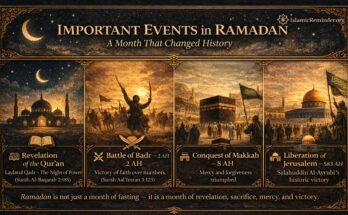
Laylat al-Qadr, the Night of Decree, is the holiest night of the year in Islam. It falls in the last ten nights of Ramadan, and worship on this one night is better than worship over a thousand months. Allah has kept its exact date hidden, so that believers will strive throughout the final nights of Ramadan.
What Is Laylat al-Qadr?
Laylat al-Qadr (لَيْلَةُ الْقَدْرِ) is the night on which the Qur’an was first revealed. Allah says that He sent it down on a blessed night, and that on this night every wise matter is decreed (Surah Ad-Dukhan 44:3-4). It happens in Ramadan, the month in which the Qur’an was revealed (Surah Al-Baqarah 2:185).
The word Qadr carries two meanings, honor and decree. It is a night of great honor, and a night on which the angels record what Allah has ordained for the coming year.
Why Is It Better Than a Thousand Months?
Allah dedicated an entire chapter of the Qur’an to this night. In Surah Al-Qadr (97), He says that Laylat al-Qadr is better than a thousand months, that the angels and the Spirit (Jibril) descend in it by their Lord’s permission, and that it is peace until the break of dawn.
A thousand months is about 83 years and 4 months, roughly a full human lifetime. A believer who spends this night in sincere worship can earn a reward greater than a lifetime of devotion.
The Prophet Muhammad ﷺ said that whoever stands in prayer on Laylat al-Qadr out of faith and seeking reward will have their previous sins forgiven (Sahih al-Bukhari and Sahih Muslim).
When Is Laylat al-Qadr?
The Prophet ﷺ taught us to look for it in the last ten nights of Ramadan, and especially on the odd-numbered nights: the 21st, 23rd, 25th, 27th, and 29th (Sahih al-Bukhari). Many scholars consider the 27th night the most likely, but no one can be certain, and the night may fall on a different odd night from year to year.
There is wisdom in this. The Prophet ﷺ once came out to tell the people the date, but two Muslims were arguing, and the knowledge was taken away. He said that this might be better for them, and told them to seek it in the last nights (Sahih al-Bukhari). Because the date is hidden, believers stay awake in worship on every one of those nights, not just one.
For Ramadan 2027, the month is expected to begin around February 8, depending on moon sighting. The last ten nights would then begin in late February.
Signs of Laylat al-Qadr
The Prophet ﷺ described one sign that appears the morning after: the sun rises that day white, without strong rays (Sahih Muslim). Scholars also mention a calm, mild night, but these signs are only recognized afterwards. You don’t need to see any sign to receive the reward. What matters is that you worship sincerely on the nights you are seeking it.
The Best Dua for Laylat al-Qadr
Aisha (may Allah be pleased with her) asked the Prophet ﷺ what she should say if she knew which night was Laylat al-Qadr. He taught her this dua (Jami’ at-Tirmidhi, Sunan Ibn Majah):
اللَّهُمَّ إِنَّكَ عَفُوٌّ تُحِبُّ الْعَفْوَ فَاعْفُ عَنِّي
Allahumma innaka ‘afuwwun tuhibbul ‘afwa fa’fu ‘anni
“O Allah, You are the Pardoner and You love to pardon, so pardon me.”
Repeat it often, and add your own personal duas in your own language.
How to Seek Laylat al-Qadr
Pray qiyam (night prayer). Stand in prayer, either Taraweeh in congregation or tahajjud at home. This is the act the hadith links directly to forgiveness.
Recite and reflect on the Qur’an. The night belongs to the Qur’an. Read what you can, and read the meaning of a few verses.
Make dua and ask for forgiveness. Recite the dua above, ask for forgiveness (istighfar), and ask for guidance, health, and success in this life and the next.
Give charity. Even a small, sincere gift counts. Many people give extra charity during the last ten nights.
Practice itikaf if you can. The Prophet ﷺ made itikaf in the last ten days of Ramadan, staying in the mosque for worship. If you can’t do the full ten days, even a short period helps.
Wake your family. Aisha reported that when the last ten nights began, the Prophet ﷺ stayed up at night, woke his family, and exerted himself in worship (Sahih al-Bukhari and Sahih Muslim). Encourage your household to take part.
Avoid sins and distractions. Reduce social media and idle talk, and protect your fast and your time.
If you are on your period or have postnatal bleeding, you can still make dua, dhikr, and istighfar, give charity, and listen to the Qur’an. Scholars differ on reciting the Qur’an in this state, so follow the opinion your local scholar teaches.
A Simple Plan for the Last Ten Nights
- Sleep a little earlier, and take a short nap in the afternoon so you have energy at night.
- Eat light at iftar so you can stand in prayer comfortably.
- Pray Isha and Taraweeh, then pray two to eight extra rakats before dawn.
- Choose one dua you’ll repeat every night, such as the dua above.
- Pick a small daily charity amount and give it each night.
- Set a Qur’an goal you can actually reach, such as one juz or a few pages with translation.
Final Thoughts
Laylat al-Qadr is an opportunity for forgiveness, mercy, and a fresh start. The Prophet ﷺ gave the last ten nights special attention, and we can follow his example. Start preparing now, and take a look at our Ramadan 2027 Complete Preparation Guide to get ready spiritually, physically, and practically.
May Allah allow us to reach Ramadan, and may He accept our worship and grant us Laylat al-Qadr. Ameen.